


Airborne LiDAR Market Trends and Opportunities: UAV-Based LiDAR & High-Resolution Imaging 2026–2035
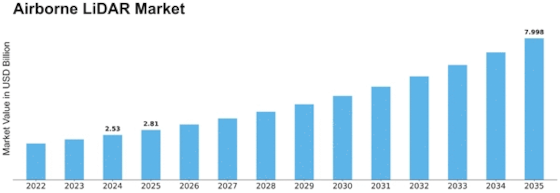
The Airborne LiDAR Market continues to gain momentum as nations accelerate infrastructure development, environmental protection, and digital transformation initiatives. With the growing need for high-accuracy geospatial data, airborne LiDAR is emerging as a core technology for planning, monitoring, and asset management.
Why Airborne LiDAR Is Becoming Essential for Modern Infrastructure
Traditional surveying often struggles with time-consuming processes and limited accuracy. Airborne LiDAR, however, enables rapid scanning of large areas with exceptional detail. This technology supports applications like roadway design, railway planning, urban expansion, and powerline inspections.
As smart cities become a global priority, municipal planners rely on airborne LiDAR-generated 3D models to assess terrain, identify obstructions, and optimize land use. The integration of LiDAR mapping solutions with GIS platforms further enhances decision-making for urban mobility, drainage networks, and construction monitoring.
Trends Driving Market Growth
A notable trend shaping the Airborne LiDAR Market is the transition from manned aircraft to UAV-enabled LiDAR systems. These unmanned platforms reduce survey costs and provide flexibility for projects requiring frequent updates.
Advancements in topographic and bathymetric LiDAR are contributing to precise flood modeling, shoreline mapping, and environmental assessments. Cloud-based processing, combined with AI classification, is speeding up workflows by automating feature extraction and terrain segmentation.
Regional Insights
Regions with major infrastructure investments—such as Asia-Pacific, North America, and the Middle East—are leading adopters. Governments increasingly utilize LiDAR data to support transportation corridors, coastal management, and climate resilience programs.
FAQs
- How does airborne LiDAR support infrastructure planning?
It provides accurate elevation and surface data, essential for layout design, terrain analysis, and risk assessment. - Is airborne LiDAR useful in rural regions?
Yes. It helps map farmlands, forest areas, mining zones, and remote locations. - Does LiDAR work during cloudy conditions?
Light cloud cover typically does not impact performance, as laser pulses can penetrate minor atmospheric obstruction. - How accurate is airborne LiDAR?
Accuracy varies by system but generally offers centimeter-level precision. - Can LiDAR help mitigate natural disasters?
Absolutely. It plays a crucial role in flood modeling, landslide detection, and environmental evaluation.

 English
 Arabic
 French
 Spanish
 Portuguese
 Deutsch
 Dutch
Dutch
 Italiano
 Russian
 Romaian
 Portuguese (Brazil)
 Greek
Greek